
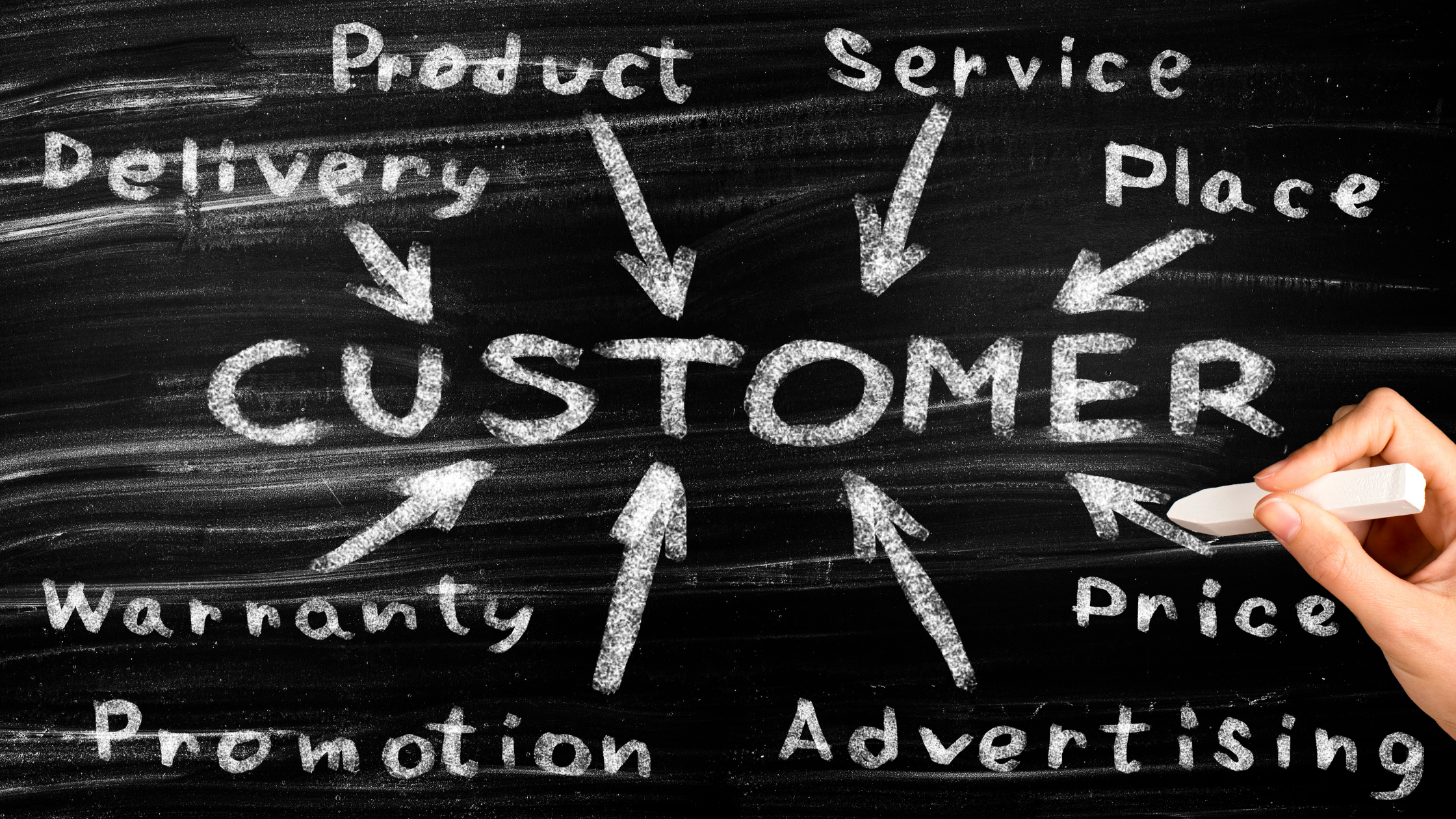
Of course, I’m talking about the Customer Journey. No matter how big or small is your business, the customer journey will follow more or less the same pattern.
While the way of approaching the customers has changed in the last decades, since our lives went more and more digital, for the most part, the customer journey is largely the same – a consumer becomes aware of your product/service, gathers information, and eventually decides to buy or not buy based off of the information.
What has changed in the classic model is the way that consumers gather information as part of the customer journey. With Google, the access to information has never been easier and a customer’s ability to compare products, companies, or services allows customers to have greater purchasing choice power.
Google refers to the search and research aspect of the customer lifecycle as the “Zero Moment of Truth” or ZMOT. Google first introduced this ideology in 2011, and with this new thinking came a lot of juicy data.
You are not mistaken when you say that the businesses who win in today’s marketing world are the ones who are most findable. When a customer is looking for a product or service, they might search on google for “tires” or “hairdresser”. This customer is looking for relevant organic search results or paid advertising that stands out to them and addresses their need for new tires or a haircut.
With every purchase comes a customer journey which can be spelled into a multitude of smaller steps.
So, what are the customer journey phases? These are distinct phases your potential customer passes through and should be guided accordingly in order to be introduced to and “buy into” your product.
If it were to map the customer journey, there are three major phases: Passive/Inactive, Active Decision and Purchase/Consumption.
But each phase of the consumer journey can be further broken in smaller pieces, and here are the expanded steps:
- Stranger
- Awareness
- Interest
- Trust
- Consideration
- Purchase
- Experience
- Retention
- Advocacy
Each has its challenges and its speed and every step involves a different set of behaviours and marketing strategies.
Stranger
In this early phase, the consumer is not yet a customer of the brand and, indeed, may not be a customer of any brand – in other words, they could potentially be a non-consumer of that product category.
Regardless of their current lack of interest in the product category they will still gain a knowledge and understanding of many brands in the market. For example, a young mother who has never bought diapers for her new-born baby is still likely to have some form of attitude towards different child care brands, such as Pampers, Huggies, and so on.
In this stage, the only thing you need to do is to produce general awareness content. That means producing SEO content, adverts and social media post that talk about their pain point.
The general communications goal of this stage would be to ensure that these “inactive” consumers become aware of the brand, have some understanding of the brand, have a positive attitude towards the brand, and would consider the brand to be a suitable brand to purchase in the future (that is, place it in the consumer’s consideration set).
Awareness
With Google and other search engines, it has never been easier or more convenient for consumers to get exactly what they want when they want it. Most of the customer journey now takes place at the fingertips of the consumer either on their mobile phone or their computer.
As mentioned above, a major portion of the customer journey involves researching a business online before a purchasing decision is made. How are consumers doing this? With the easiest and most used tool in the world for providing answers, Google.
A more specific communication goal in the Awareness phase would be to trigger the motivation for purchase. This would move the consumer from the passive/inactive phase into the decision buying process.
Interest
At some point, and for a variety of reasons and possible marketing stimulus, the active/passive consumer is motivated to purchase. Essentially, they had been “activated” as customer and will enter the standard consumer decision process model.
The decision phase of the customer journey relates to the first three steps in the standard consumer decision process model, which are:
- Need /problem recognition – which is an acceptance by the consumer that they need to buy a certain type of product category
- Information search – where the consumer will gather relevant information to help them choose between competing brands
- Evaluation of alternatives – when the consumer has gathered enough information, they will make an assessment of the best brand/product solution for their needs
Trust
Online reviews: they are a great way for customers to understand whether or not a business offers good customer service. Nobody wants to spend their money at a shady business, and customers will look to see if a business is positively received by other consumers.
Social Media Marketing: Do customers like you? Your sister may absolutely love shopping for stationery at a local shop, and she isn’t shy about sharing her admiration of the local business to her entire Facebook friends list! Any business, online or offline, must be sure that they not only acknowledge social media activity but utilize online conversation to frame their brand positively.
If your customer happens to read a lot of negativity about your business, it is likely they will continue searching for a business until they find a place they are wanting to do business with.
Consideration
As you can see, this phase maps mainly their information, choice and decision a phase of their customer journey. While they would already have a brand consideration set loosely formed in their mind (from the aggregate brand touchpoints in phase one), some consumers will willingly add/detract from this brand set as result of the research that they make during this phase.
However, consumers are more likely to purchase a brand that is already in their consideration (evoked) brand set.
Purchase
Once the consumer has decided to purchase the product or service, they then move on to the final two steps of the five-step decision process, which are:
Purchase and consumption – here the consumer usually enter a retail setting (either physically or online) to complete the purchase – but they still may be influenced by in-store offers, displays and sales people
The decision is made, and the purchase has gone ahead, this is now the tie for immediate action. Do not leave a void in between this phase and first contact. The customer needs to be acknowledged. Startup your welcome and messaging machine to progress the journey with a great experience and a chance to move them into further phases.
Experience
A river of ink was spent on the customer experience, so I’ll not emphasise that. Post-purchase behaviour – this is the level of customer satisfaction and resultant behaviour after purchase and consumption.
In this phase, the consumer actually becomes a customer of the firm/brand. This could be for the first time or they could be making a repeat purchase decision.
It is through the purchase and consumption step in particular that the customer is heavily interacting with the brand/firm and its staff and facilities (if a service firm). It is typically this phase that is primarily explored in a customer experience map and/or a service blueprint.
Retention
If your customer is impressed with your product upon first sight, that’s great. But that will wear in time. You need to seek to impress your customers on an ongoing basis, with new and great updates, free courses, support, badges or whatever your customers perceive to be new and impressive!
Advocacy
If all the other phases are handled correctly, then your customers will become fans, fans will provide the best marketing you can get. Their influence on the purchasing decisions of others should facilitate further sales. At this point recommendation and reward is a great boost to improve sales.
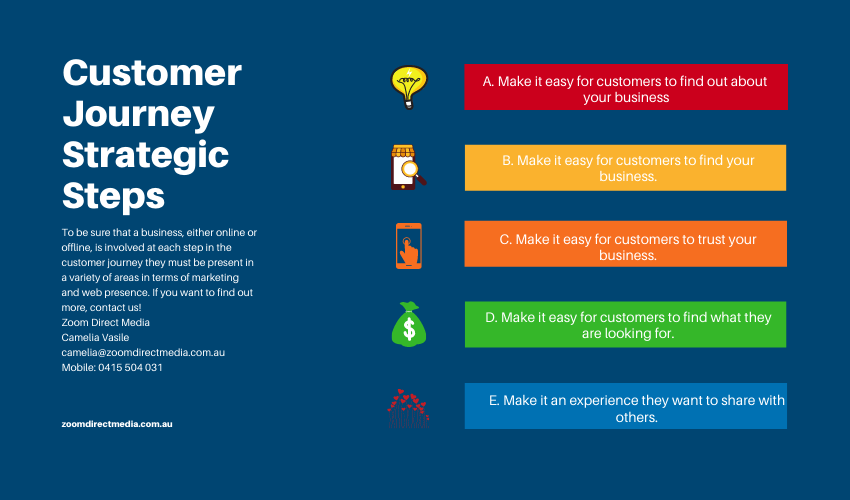
To be sure that a business, either online or offline, is involved at each step in the customer journey they must be present in a variety of areas in terms of marketing and web presence.
So, ask yourself the following questions, and if you’re not satisfied with the answer, give me a call and we’ll improve them together.
Advertising Services (SEO, PPC): Do potential customers know about you?
Listings (Google My Business): Can customers find you?
Reputation Services: Do customers trust you?
Social Media Marketing: Do customers like you?
Website Services: Will customers convert into sales?
CRM/Loyalty: Will they remain loyal?